The phrase "hire a Ruby on Rails developer" covers four very different hiring paths in 2026, and most teams pick the wrong one. This guide compares direct employees, freelancers, marketplaces, and agencies, with real US salary data, real ramp-up costs, and the cases where each is genuinely the right answer.
JetRockets has been Rails-only for 15+ years, with 80+ verified Clutch reviews and a co-founder on every engagement. We have no incentive to oversell agency partnerships, because some Rails hires really should be direct. This guide names those cases.
What Problem Are You Actually Hiring to Solve?
"Hire a Ruby on Rails developer" is too broad to be useful until the underlying business need is clear. Two companies using that exact search phrase often need completely different people.
Sort the problem first. Are you building new features on a healthy Rails codebase and need ongoing product development capacity? Are you stabilizing a legacy monolith and need someone who can read old code safely without breaking production? Are you shipping a Rails upgrade or performance optimization on a fixed timeline? Or is the team blocked less by coding capacity and more by who is making the architecture calls?
These are different roles with different ideal candidates. A great Rails product builder is not the same person as a Rails rescue engineer. A coder who ships features quickly is not the same person who can make the right architectural tradeoff under pressure. Treating these as interchangeable is the single most common cause of a bad hire in Rails.
Two Rails Codebases, Two Different Hiring Markets
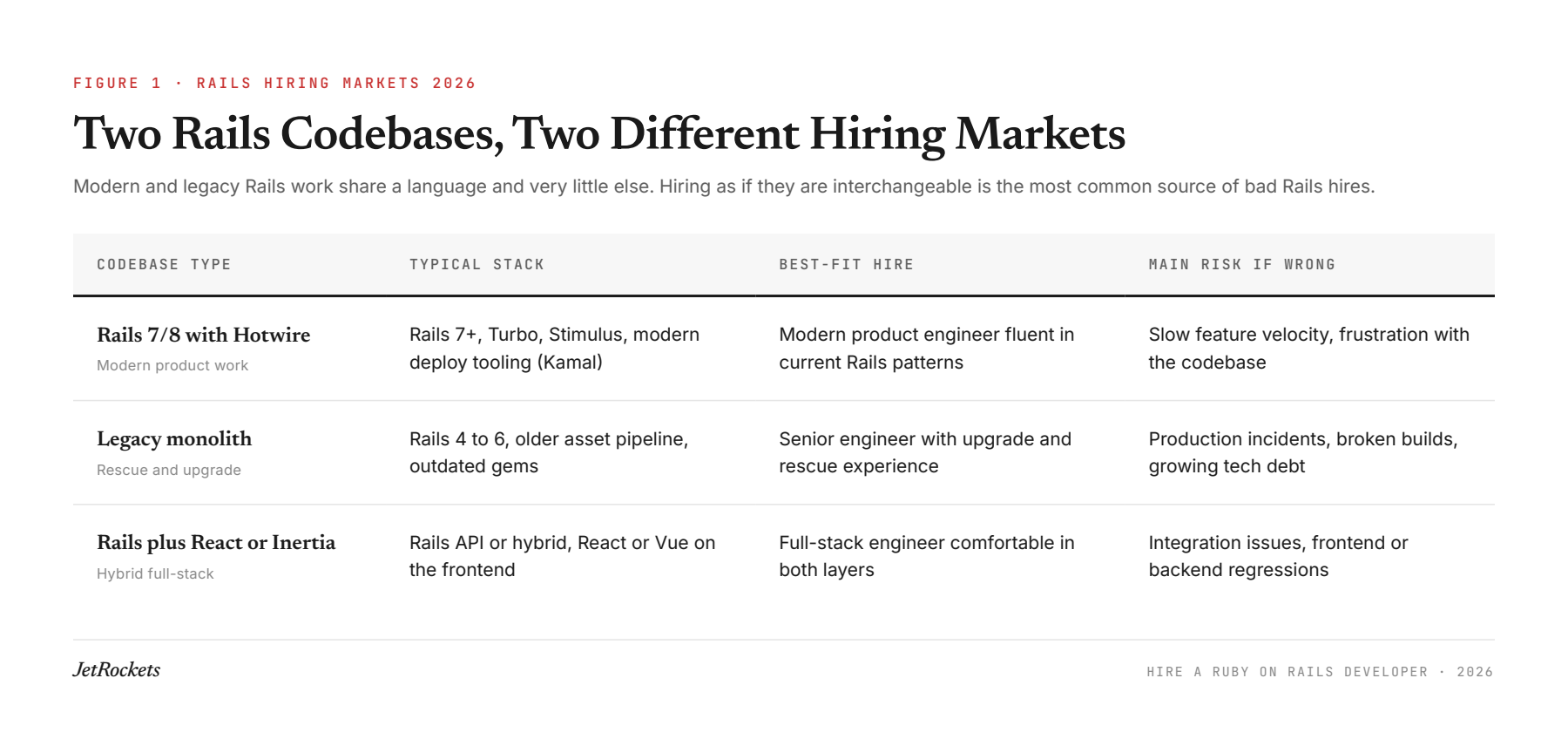
There are effectively two Rails hiring markets in 2026, and most founders do not realize they are shopping in the wrong one. Modern Rails 7 and 8 codebases with Hotwire, Turbo, and Stimulus need engineers who are up to date on contemporary delivery patterns. Legacy Rails 4 to 6 monoliths need engineers who can debug hard production issues, handle careful refactors, and ship upgrades without destabilizing the business.
These roles share a programming language and very little else. The wrong hire most often happens when a company assumes a modern product builder and a legacy rescue engineer are interchangeable. They are not.A job posting that does not specify which of these codebases the engineer will work on is doing both sides a disservice.
Why Rails Hiring Feels Harder in 2026
The Rails hiring market has tightened. The pool of working senior Rails engineers has narrowed as some moved into engineering leadership and others moved into adjacent stacks. Meanwhile, the installed Rails codebase is very much alive. Stripe, Shopify, GitHub, Airbnb, and a long list of post-MVP startups still run Rails in production.
The result is a supply-and-demand mismatch. The recruiting narrative moved away from Rails faster than the actual codebase footprint did. That gap is why senior Rails engineers are scarce, why offers are clearing at higher-than-published averages, and why direct-hire searches in the US are running 5 to 8 weeks before a credible offer is on the table.
That changes the buyer's calculus. A longer direct-hire search is not always the smartest move when the business need is urgent. Sometimes the right sequence is clarity first, stabilization second, and hire third.
What Ruby on Rails Talent Actually Costs in 2026
Salary benchmarks vary depending on who is publishing them. Use specific numbers and confirm the source.
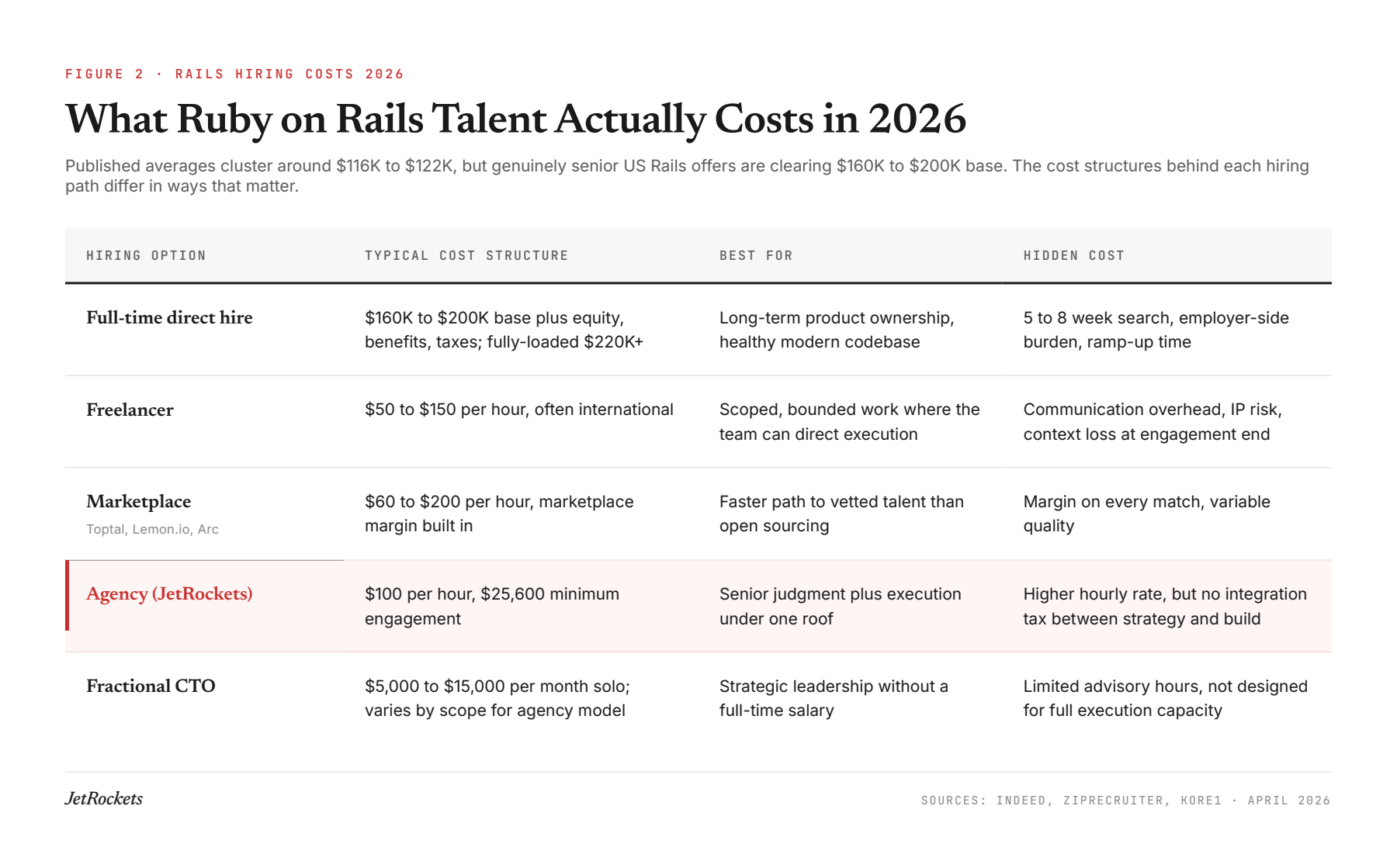
Indeed currently lists the average US Ruby on Rails Developer salary at $116,667 per year, with a reported range of $75,870 to $179,403. The figure is based on 168 salaries from job postings over the past 36 months and was updated April 29, 2026. ZipRecruiter currently lists the US average at $122,113 per year, or about $58.71 per hour. Most roles cluster between $102,500 and $140,500, with the 90th percentile at $163,500.
Both averages run below what offers actually clear for genuinely senior Rails work in major US markets. KORE1's published benchmarks put senior US Rails compensation at $160,000 to $200,000 base for the right candidate in 2026. Published averages are pulled toward the mid-career middle, not the senior end, where most hiring pain is concentrated.
JetRockets publishes our own pricing for direct comparison. The minimum build engagement is $25,600, and ongoing retainers start at $22,000 a month. The numbers live on our FAQ page, because pricing should be public.
Direct Hire vs Freelancer vs Marketplace vs Agency
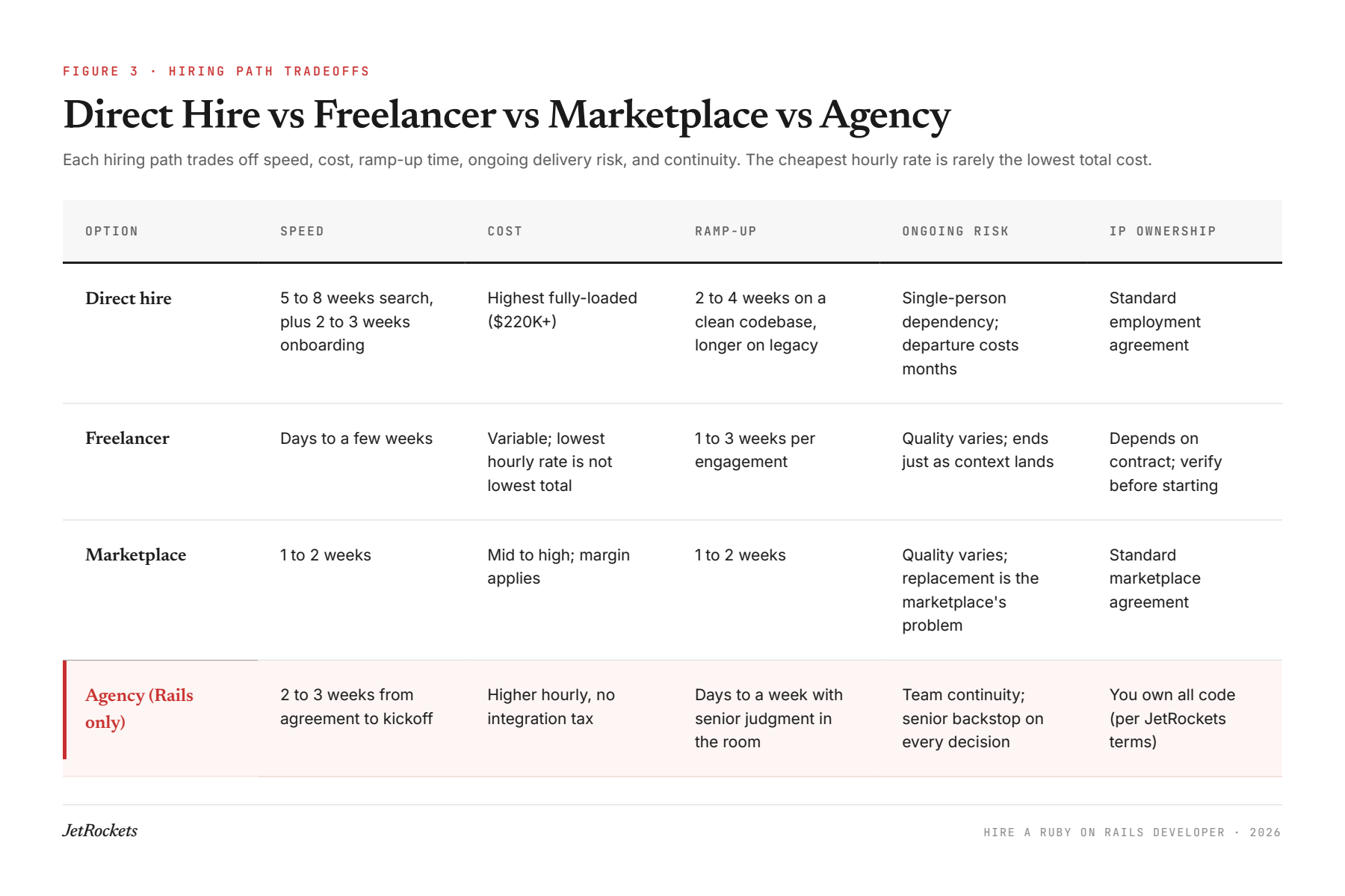
Each hiring path trades off speed, cost, ramp-up time, ongoing delivery risk, and continuity. "Cheapest" and "lowest risk" are rarely the same path.When each path is the right fit:
Direct hire fits when the codebase is healthy, the roadmap is clear, the internal team has the leadership to onboard and direct the person effectively, and you need long-term product ownership.
Freelancer fits when the work is narrow, bounded, and your team can manage quality tightly. A scoped Rails upgrade slated for a single sprint with a freelancer who has the right references can be the right call.
Marketplace fits when you know exactly the profile you want, your team can vet the match quickly, and you can tolerate the margin built into the rate.
Agency fits when the need includes speed, continuity, broader support around architecture, or you cannot absorb the integration cost between a freelancer and the existing engineers.
When One Senior Rails Developer Is the Right Hire
A direct individual hire is often the right move. This is the case; JetRockets is not going to spin against, because it is genuinely true for the right teams.
The conditions where a senior direct hire works best: the Rails product is healthy and modern (Rails 7 or 8 with Hotwire), the roadmap is clear enough to scope a real role, internal leadership exists to onboard the person and direct their work, and the company can absorb a 5 to 8 week search.
What makes the hire actually succeed: scope the role around a specific codebase and a specific kind of work, not "we need a Rails developer." Pay at the senior end of the range when the work is genuinely senior. Run a Rails-specific interview rather than a generic algorithm screen. DistantJob, KORE1, and TalentMSH all push toward job-relevant evaluation rather than LeetCode loops, and the reason is simple: a Rails-specific interview catches the right candidate, while a LeetCode interview catches whoever practices LeetCode.
If the codebase is fragile, the roadmap is unclear, or the team has no senior technical voice to onboard the hire, a direct hire alone is usually not enough.
When an Agency or Fractional CTO Is the Better Call
If the codebase is fragile, outdated, under-documented, or strategically unclear, a single new engineer often does not fix the real problem. KORE1 explicitly notes that some teams should pause the requisition and have the architecture conversation first.
The two alternatives to a direct hire serve different needs.
Agency partnership is stronger when the buyer needs immediate delivery capacity, team continuity, and less single-person risk. A Rails-only agency partnership covers strategy and execution under one roof. The senior judgment is in the room from day one. The work continues if one engineer is unavailable. The contract makes IP ownership and confidentiality explicit. JetRockets structures these engagements through our Ruby on Rails Development service, with co-founders on every engagement.
A fractional CTO is stronger when the real gap is technical leadership, architecture direction, prioritization, or deciding whether to keep investing in Rails at all. If the hire you actually need is senior technical judgment, a few days a week, not a permanent salary, the Fractional CTO model is built for that. For founders weighing this against a senior hire, What Is a Fractional CTO? A Plain English Guide for Startup Founders is the foundational read.
If you are pre-MVP and considering hiring your first Rails engineer, the right structure is often closer to an MVP development partnership than an individual hire. The Non-Technical Founders service is built specifically for founders without a technical co-founder. If the engagement you need is scoped to a specific upgrade, the Ruby on Rails Upgrade service is what a project-based engagement looks like.
Not sure whether you need a new hire or a cleanup of the existing codebase? Start with a free Rails code audit. We review the architecture, performance, and security, and deliver a written report within 2 to 3 days. No commitment.
What a Strong Ruby on Rails Developer Looks Like in 2026
Senior Rails markers in 2026 differ slightly by codebase type, but the underlying judgment overlaps across types.
For legacy work: upgrade experience across major Rails versions. Performance profiling and N+1 detection. Careful refactor habits. Safe change management on production codebases with weak test coverage. Patience with code written by someone who left three teams ago.
True senior markers across both: ActiveRecord performance and query optimization. Background job design and reliability thinking (Sidekiq, Solid Queue). API design and system tradeoffs. Testing discipline. Product judgment about what to ship and what to delay.
The buzzword filter: a candidate who can describe a specific architecture decision they made, what they rejected, and why is genuinely senior. A candidate whose answers stay generic is not, regardless of years on the resume.
How to Interview Rails Developers Without Wasting Time
The fastest way to waste both sides' time is a generic algorithm interview that has nothing to do with Rails work. The fastest way to get a useful signal is to build a screen on actual Rails problems.
For modern Rails roles: short, job-relevant screens on query optimization, API design, background jobs, code review, and production reasoning. A 90-minute structured technical interview pulls more signal than a five-round LeetCode loop.
For legacy Rails roles: hand the candidate a slice of anonymized legacy code from your codebase and ask them to walk through how they would debug it, safely ship a small change, or plan an upgrade path. DistantJob explicitly recommends this approach, and it is how senior judgment surfaces fastest.
What the process should reveal: how the candidate thinks through tradeoffs, whether they can explain decisions clearly to a non-technical founder if one is in the loop, and whether their Rails background matches your actual codebase rather than Rails in the abstract.
How to Avoid a Bad Rails Hire
The most expensive Rails hires fail for predictable reasons.
Treating all Rails roles as the same. Modern product work and legacy rescue are different jobs. The interview process and the success criteria should reflect that.
Under-budgeting for senior talent. A $90K offer for a $160K market role gets you a $90K engineer. The work suffers, and you will likely re-hire inside 18 months.
Hiring for keyword match instead of codebase fit. "Five years of Ruby on Rails" tells you almost nothing. Five years on, what kind of Rails work, on what kind of codebase, at what level of seniority, is the real question.
Using a slow, irrelevant interview process. Generic algorithm puzzles do not surface Rails judgment. Real Rails problems do.
Hiring implementation capacity when the real need is technical direction. If the team needs someone to make the architecture call rather than execute on an existing one, a Fractional CTO or an agency partnership is the right engagement model.
Trusting the title without testing the judgment. "Senior Rails developer" is sometimes three years of experience and a confident opinion. Specific architecture questions surface the difference.
Practical red flags during interviews: candidates who cannot reason about performance or background jobs, who only know the happy path of one Rails style, and job descriptions that read like they were generated from a template.
Conclusion
The right Rails hire in 2026 depends on the problem you are actually solving. A direct hire fits modern product work, a healthy codebase, and senior internal leadership. A freelancer fits narrow, bounded work where your team can direct execution. A marketplace is a good fit when you know the exact profile and can manage quality. An agency is a good fit when you need strategy and execution under one roof, especially for fragile or strategically unclear codebases.
If you have an existing Rails codebase and you are not sure whether you need to hire, stabilize, modernize, or rethink the architecture, the free Rails code audit is the lowest-friction starting point. Architecture, performance, and security findings in 2 to 3 days, no commitment.
For deeper conversations, contact us directly, and you'll talk to a co-founder, not a salesperson. We respond within one business day. The full Rails service range covers the range from MVP to Fractional CTO.
Frequently Asked Questions
What does a senior Ruby on Rails developer cost in 2026? Published averages on Indeed and ZipRecruiter cluster around $116,000 to $122,000 per year for US Rails developers, but those numbers pull toward mid-career. Genuinely senior Rails offers in major US markets are clear at a $160,000 to $200,000 base salary in 2026, per KORE1's published benchmarks. Fully-loaded cost, including equity, benefits, and employer taxes, typically runs 1.3 to 1.4 times the base salary.
When is a freelancer enough, and when is an agency the better fit? A freelancer is the right answer when the work is narrow, bounded, the team can direct execution, and you can tolerate the engagement ending when the contract ends. An agency is the better fit when the work needs continuity, when senior architecture judgment is required from day one, or when the team cannot absorb the integration cost between a freelancer and integrating them with the existing engineers.
How can I tell if I need a Rails developer or a Fractional CTO? Ask what the bottleneck actually is. If the team can execute on direction but does not have anyone making senior technical decisions, a Fractional CTO closes that gap. If the team can make decisions but does not have the capacity to ship, a developer or agency closes that one. The wrong hire happens when teams hire execution when they need direction, or direction when they need execution.
What is the fastest way to avoid a bad Rails hire? Sort the actual business problem before sourcing candidates. Pick a hiring path that fits the problem rather than the keyword. Run a Rails-specific interview rather than a generic algorithm screen. Pay at the senior end of the range when the work is genuinely senior. And acknowledge directly when the right answer is not a single new hire at all.
Should I hire into the current Rails stack or reassess the architecture first? If the codebase is healthy and the roadmap is clear, hire. If you are not sure what shape the codebase is in or where the technical debt is concentrated, a free Rails code audit answers that question in 2 to 3 days before you commit to a multi-month search.
Can JetRockets help if I am not ready to hire yet? Yes. The free Rails code audit gives you an architecture, performance, and security review of the existing codebase with no commitment. The Fractional CTO engagement covers senior judgment without a permanent salary. The MVP and Non-Technical Founders services cover earlier-stage builds where an individual hire is not yet the right shape of the engagement.